Showing posts with label politics. Show all posts

Thursday, February 12, 2015

Is it ever moral to desert?

My old friends know that I used to think like they do....so there is really nothing for me to consider when it comes to their view point...what grieves me is that (for the most part – I'm not going to lump all my friends together) they won't stop to examine or consider my point of view.   Maybe I have learned something that they haven't, maybe I can see a bigger picture they can't yet.  Maybe my eyes and heart are open to seeing that the Emperor is wearing no clothes. I'm not taking any credit. I know that only God opens eyes. Indeed it is a grave thing to be burdened by so much knowledge. The grief of knowing - the grief of others not seeing - it's all too much sometimes...

The photo that started it all.


We may never know the entire truth about this particular case (Sgt Bowe Bergdahl). The real issue it whether it's moral/just/right for someone to desert (break a contract) when they discover they have been lied to and are merely pawns/cannon fodder for the multi-national corporate interests/global elite. When they discover their mission is protecting poppy fields or territory for oil pipelines or rich mining resources. Or toppling a leader so a more “favorable one” (to US interests) can be installed.

22 suicides per day according to official records, 800,000 plus vets are homeless, how many can't live with themselves for the atrocities they committed or enable others to? Not to mention the fact that they are guinea pigs for pharmaceutical companies! God only knows how many lives and families are ruined as a result.


When did it become “okay” for a “christian nation” and flag waving church goers to champion invasion, death, destruction, plundering, genocide even - all in the name of “patriotism” or rather “nationalism” (expansion/exceptionalism, imperialism)?

Take a look at the history of America from sources beyond the approved government texts. Look at the history from victims' narrative instead of the victor's. When you realize what the Fed Govt of these United States has done over and over again you will never again believe official sources, official news stories coming from the “ministry of truth” and their approved outlets of propaganda – fear mongering, war mongering, fanning the fires of hate, prejudice, distracting, dividing, creating enemies so they can justify and gain support for the latest invasion - annihilation - destruction. It's the same play book they've used for years.

Why do people still believe it? Keep falling for it?

Because if you tell a lie often enough it becomes “truth” - quoting Goebbels. Because if you control the mainstream news outlets and have agents as “journalists” you control what people see, think and “know” - because you can plant disinformation and set up kooks in alternative news outlets to discredit sources outside the mainstream propaganda. When the same corporations who report the news also profit from the perpetual “war on terror” you won't hear the real story. Why would they report something that harms their bottom line? I've read that all mainstream media is controlled by just SIX corporations. You won't get “fair and balanced” from any of them. Just slightly different flavors of left or right and an illusion of any real difference between them!

Because people for the most part are comfortable and don't want their ideas, their beliefs challenged. I know I didn't! It's too much to even consider – that most everything we've been told and learned is fiction or that our tax money pays for CIA covert ops, coups, regime change, assassinations, terror cells, false flags, plundering for the multinational corporations, which ALL result in BLOWBACK. 

The enemies are created for a reason...perpetual war, control of resources, depopulation and billions in profits for military industrial complex, oil companies, those in power, etc. etc.


Monday, April 23, 2012

The man knows of what he speaks!

Retired US Marine Major Christopher Miller gave a  speech at his GOP Congressional District 3 convention. We would do well to listen to the man...
Embedded:


Friday, October 7, 2011

Day Two Protest the banking system (and the wars!)

We were at the Fed from about 3:30 to 9:00 last night. We met some really great folks and had a good time visiting. I encouraged everyone I talked with to spread the message, especially to the Occupy Dallas folks, that's really what we were there to do.

A couple of OD guys came over and tried to get us to join them at Pioneer Plaza. They said there were only about 70-80 of them over there. We said come join us!! They finally did come (escorted by the police!) and stood across the street. We tried to wave them over, but they mostly stayed over there. Some of them were with us and some of us were over there. Don't listen to the media hype about this, they will marginalize us as they always do. Try to keep us from realizing how similar we are. They don't want us to join or work together!

We ended up chanting together a few times and they seemed to listen when Alex spoke directly to them (across the street with bullhorn). Many of the sign messages on either side of the street said the same thing. I suggested to them they chant "this is what America looks like" instead of using the word democracy!

All in all it was a great event. I personally didn't listen to Alex or any of the others, I just spent my time talking to the folks on the outside edges of the crowd and the ones coming and going and I passed out another 100 flyers. We had about 250-300 in attendance if you include the 50 or so across the street! I really wished I could have met and visited with everyone! And yes, I got a lot of "oh! you're Debbie McKee, I heard you on the radio yesterday! You sounded so nice, not like Alex!".

One photographer recognized Adrienne and said that a photo he took of her with her sign on Thursday went global/viral by that evening. It was put out there for news agencies, etc. to pick up and use and away it went! If anyone sees it PLEASE let us know where we can find it. Another time when we protested Bernanke's visit to Dallas a Reuters photo of her also went global. That's quite fun!

I encouraged everyone who could to go join the OD folks at Pioneer Plaza afterward to mix and mingle, spread the message. That is what is about folks!!!! If you have any free time to spend working on this, PLEASE do!!!! Find them and talk with them. Take flyers, DVDs, whatever you can.

It's about the message not the candidates, remember, the message is MOST important in the long run.

Debbie McKee
taking a well deserved break!
~~~~~~~~~~~~~~~~~~~~~~~~~~~~~~~
PS the strangest thing was that as the organizer for the usual End the Fed rallies, I always am the first to arrive and the last to leave, pick up the trash, etc. then the police leave. Well, I had to tell the detective we've worked with since 2008 that I had to leave and I'd encouraged folks to move on over to Pioneer plaza, but that was all I could do! So, there were about 40 people still there when we left and more trash than I could deal with, I did pick up some. As we walked by and said goodnight to the FED security guys, they were really friendly and nice! We also told the police thank you for their service. They were spread really thin this weekend because of the Fair, the Texas/OU game, Occupy Dallas, and us. I hope tempers don't get short from long, boring, but stressful hours. I told our detective friend that there would likely be a trickle of folks there off and on. I couldn't tell who or how many.


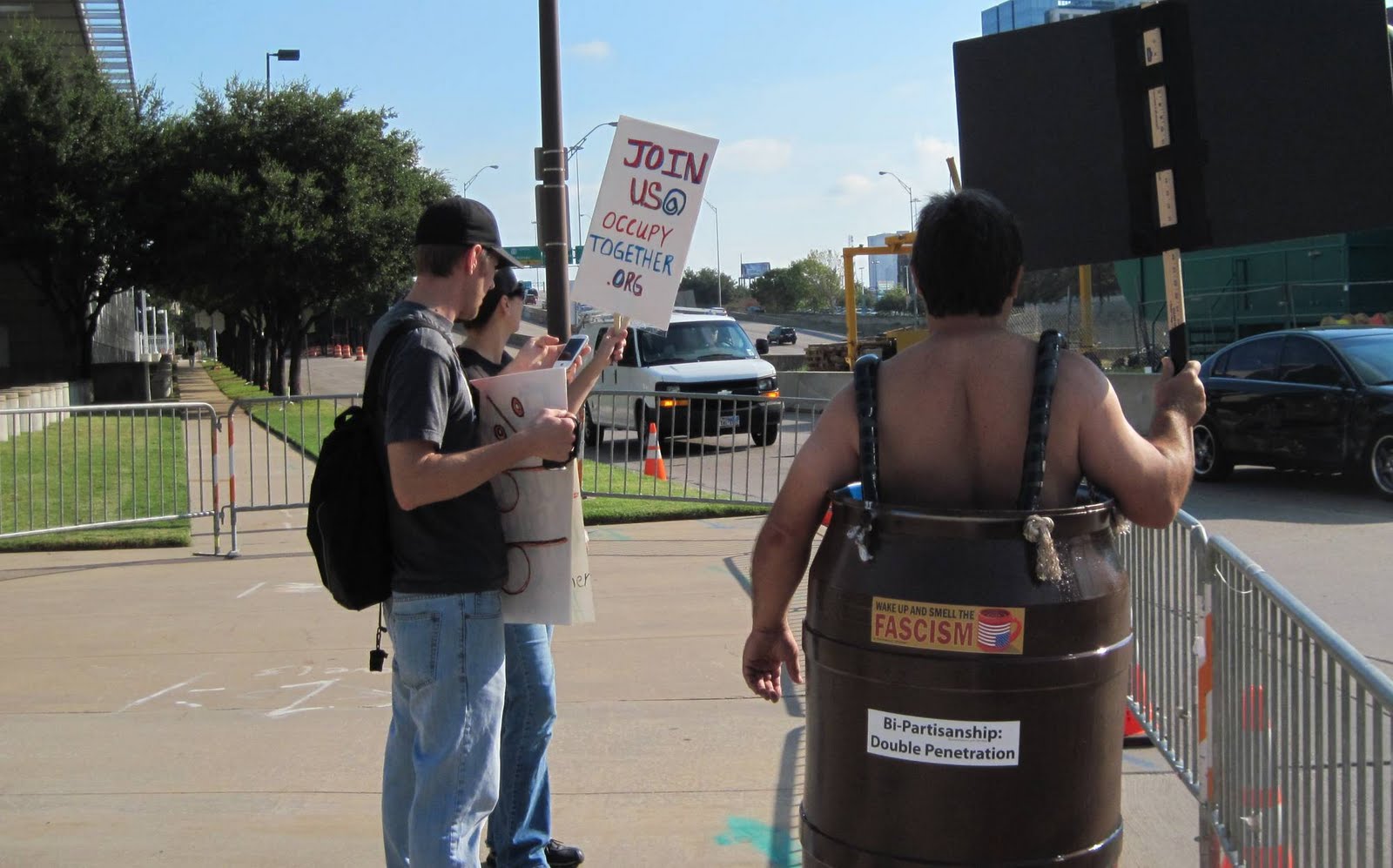
Occupy Dallas protesters...A man with us yelled: "Red rover, red rover, let Occupy come over!!!" =)


(Adrienne thought that this photo was interesting, so that's why it was posted...)

Thursday, October 6, 2011

Photos from the first day...

...of Occupy Dallas protest & End the Fed rally.


brief report:

Adrienne and I just got back home. We were there from a little before 9 AM (first ones there) and left about 11:15 to make the phone interview with Alex Jones in my car phone booth. I didn't do a great job, but hey, I was very hot in my closed up car and tired! We had to work our way through the marchers to get to our car. DPD said they had about 300 people, it could have been more, we were pretty crowded on the sidewalk.

The Dallas Observer interviewed me. Lots of us were out there. I met a student from TCU who is involved in YAL. Many liberty minded folks seemed to just come because they saw the Occupy Dallas website. DPD set up barricades so we were penned in. That was rather an uncomfortable feeling.

As the marchers arrived I passed out my flyers (only brought 100) and said "I'm glad you are here, we've been protesting the Fed since November 2008!"

The amount of press was unbelievable!!!

They didn't hang around on the hot sunny corner very long before they started calling for marching on Chase bank across the street! They ended up mostly up the street a little way under the trees! We ALWAYS hang out where the traffic can see us!

PLEASE COME OUT TOMORROW!!!! Alex is speaking around 5:30. He said he'd share his bullhorn, but he doesn't realize I'm not the bullhorn type!

So, I need some back up!!!!


"Our troops are cannon fodder for the Power Elite."

"Looting U.S."


There were some great signs, some thought provoking ones. Like "what's our oil doing under their sand?", "Who would Jesus Bomb?" and "we want a Revolution - of thought". Several End the Fed signs!! And a couple of Don't tread on me! flags!!


My main purpose in activism efforts is to help people see what is really going on. Whether it's political campaigns or tea parties or end the fed. It's ALL about reaching out to help wake people up. The message is sooo much more important than ANY personality or election. Some will listen and investigate, some won't. Duty is ours, results are God's. Revolution means a change in thinking and I believe we can see it coming.


Monday, September 5, 2011

Tyrannical Power is Absolute.....


"[Tyrannical] power is absolute, minute, regular, provident and mild. It would
be like the authority of a parent if, like that authority, its object was to
prepare men for manhood; but it seeks, on the contrary, to keep them in
perpetual childhood: it is well content that the people should rejoice,
provided they think of nothing but rejoicing. For their happiness such a
government willingly labors, but it chooses to be the sole agent and the only
arbiter of that happiness; it provides for their security, foresees and
supplies their necessities, facilitates their pleasures, manages their
principal concerns, directs their industry, regulates the descent of property,
and subdivides their inheritances: what remains, but to spare them all the care
of thinking and all the trouble of living?"
-- Alexis de Tocqueville
[Alexis Charles Henri Maurice Clerel, le Comte de Tocqueville] (1805-1859) French historian
http://quotes.liberty-tree.ca/quote_blog/Alexis.de.Tocqueville.Quote.62D1

Thursday, August 25, 2011

When Martin Luther King Reached the Point of No Return


shorter version here

original post here

By John W. Whitehead
8/25/2011

"I have begun the struggle and I can't turn back. I have reached the point of no return."--Martin Luther King Jr.
The official dedication of the Martin Luther King Jr. National Memorial is scheduled to take place on Sunday, August 28th, the 48th anniversary of King's famous "I Have a Dream" speech. If anyone deserves a national monument in his honor, it would certainly be Martin Luther King Jr., a man who inspired countless Americans, including myself, to take a stand against injustice.

King was an amazing individual: courageous, passionate about freedom, willing to tackle large-scale issues (such as materialism, militarism and the Vietnam War), and relentless in his pursuit of justice--he stood his ground, even in the face of death threats and opposition from friends and associates. A warrior and a visionary, King saw first-hand what tyranny looked like and worked tirelessly to oppose it. As King observed, "The universe is on the side of justice."

King's journey to the "mountaintop," as he put it, began with a boycott in Montgomery, Alabama. City officials had done everything possible to stem the boycott of their segregated bus system by the black citizens of Montgomery. Inevitably, the city resorted to what had always worked in the past: the use of police power.

The date was January 26, 1956. It was in the afternoon, and the young minister of the Dexter Avenue Baptist Church, was on his way home with two fellow church members. The acknowledged leader of the highly controversial boycott, he was put on notice to follow the traffic laws meticulously. There was no reason to make himself an easy target for arrest. But, as fate would have it, the police targeted the young minister, and he was arrested: "Get out King; you are under arrest for speeding thirty miles an hour in a twenty-five mile zone."

Thus began Martin Luther King Jr.'s journey toward jail. The moment of truth, however, had arrived for the young minister. Warned that he could be made to disappear by the authorities, fear began to grip King. As he writes:
As we drove off, presumably to the city jail, a feeling of panic began to come over me. I had always had the impression that the jail was in the downtown section of Montgomery. Yet after riding for a while I noticed that we were going in a different direction. The more we rode the farther we were from the center of town. In a few minutes we turned into a dark and dingy street that I had never seen and headed under a desolate old bridge. By this time I was convinced that these men were carrying me to some faraway spot to dump me off. "But this couldn't be," I said to myself. "These men are officers of the law." Then I began to wonder whether they were driving me out to some waiting mob, planning to use the excuse later on that they had been overpowered. I found myself trembling within and without. Silently, I asked God to give me the strength to endure whatever came.
This was at the height of segregation in the American system. It was a time where, when blacks got out of line, at a minimum they faced jail time. Only a month earlier, Rosa Parks, a seamstress, had refused to give up her seat on a Montgomery bus to a white man. This violation of the segregation law brought a swift arrest.

But King by now was the troublemaker. Cut off the head and the movement dies. This King knew. That is why he began to panic as his ride with the police continued:
By this time we were passing under the bridge. I was sure now that I was going to meet my fateful hour on the other side. But as I looked up I noticed a glaring light in the distance, and soon I saw the words "Montgomery City Jail." I was so relieved that it was some time before I realized the irony of my position: going to jail at that moment seemed like going to some safe haven!
As the jail doors slammed shut behind King, he felt a strong inner peace: "For the moment strange gusts of emotion swept through me like cold winds on an open prairie. For the first time in my life I had been thrown behind bars."

Soon King's bail was posted and King was free to leave. But King's rendezvous with jail cells was just beginning. More importantly, the movement that began in Montgomery was moving beyond state borders. A nationwide movement with a capital M was in process. This made King even more of a target.

Several weeks later, King happened to be in Nashville giving a lecture when he learned that he, with others, had been indicted by a grand jury for violating Montgomery's segregation laws. He immediately booked a flight home, stopping over to see his father in Atlanta. Martin Luther King Sr. recognized that a new scenario had developed. The threat was no longer jail time. It was death. "My father, so unafraid for himself," writes King, "had fallen into a constant state of terror for me and my family."

Earlier, King's home in Montgomery had been bombed and the police were watching his every move. After the bombing, King's mother had taken to bed under doctor's orders. King's father brought some of Atlanta's leading citizens into his home to speak with his son about the dangers of returning to Montgomery. But King knew that often courage in the face of tyranny is all that the oppressed have at their disposal. It was time, as King said, to take a stand. As he told those assembled:
My friends and associates are being arrested. It would be the height of cowardice for me to stay away. I would rather be in jail ten years than desert my people now. I have begun the struggle, and I can't turn back. I have reached the point of no return.
Upon arrival in Montgomery, King headed for jail to discover that the others indicted with King had the day before surrendered for arrest. "A once fear-ridden people had been transformed. Those who had previously trembled before the law were now proud to be arrested for the cause of freedom."

Against incredible odds, the blacks of Montgomery won the right to be treated equally on the city's buses. Soon, the movement took on amazing proportions which would compel a government that refused to hear their pleas to listen and heed their demands. But not a shot was fired by the blacks of Montgomery. Led by a man who believed in nonviolent resistance to government oppression--a man who believed that governments must listen to and heed our demands, these brave people would soon transform the face of America.

Few suspected that King's voice would be prematurely silenced, but King knew his days were numbered. He knew there was a larger force at work in his life. And that's how he concluded his sermon--the last words he spoke in public:
Well, I don't know what will happen now. We've got some difficult days ahead. But it doesn't matter with me now. Because I've been to the mountaintop. And I don't mind. Like anybody, I would like to live a long life. Longevity has its place. But I'm not concerned about that now. I just want to do God's will. And He's allowed me to go up to the mountain. And I've looked over. And I've seen the promised land. I may not get there with you. But I want you to know tonight, that we, as a people will get to the promised land. And I'm happy, tonight. I'm not worried about anything. I'm not fearing any man. Mine eyes have seen the glory of the coming of the Lord.
Forty-three years after King's assassination, our nation is still plagued with wars, government surveillance and a military-industrial complex that feeds a national diet of warmongering. And King, once a charismatic leader and voice of authority, has been memorialized in death to such an extent that younger generations recognize his face but miss out on his message. Yet he still speaks volumes to us today.

"Speaking truth in times of universal deceit is a revolutionary act," George Orwell once said. Such was Martin Luther King. They may have killed the man, but his spirit of truth lives on. We would do well to learn from him how to speak truth to power.

Saturday, August 20, 2011

TINY ICELAND SHOWS US THE WAY WITH THEIR ON-GOING FINANCIAL REVOLUTION

"They should look to Iceland. Refusing to bow to foreign interests, that small country stated loud and clear that the people are sovereign. That’s why it is not in the news anymore." Hmmm. Sound familiar, RP supporters? JG


TINY ICELAND SHOWS US THE WAY WITH THEIR ON-GOING FINANCIAL REVOLUTION. by Deena Stryker
http://www.freestatevoice.com.au/politics/item/811-tiny-iceland-shows-us-the-way-with-their-on-going-financial-revolution-by-deena-stryker

A LESSON TO BE LEARNED BY ALL AUSTRALIANS.

An Italian radio program's story about Iceland’s on-going revolution is a stunning example of how little our media tells us about the rest of the world. Americans may remember that at the start of the 2008 financial crisis, Iceland literally went bankrupt. The reasons were mentioned only in passing, and since then, this little-known member of the European Union fell back into oblivion.

As one European country after another fails or risks failing, imperiling the Euro, with repercussions for the entire world, the last thing the powers that be want is for Iceland to become an example. Here's why:

Five years of a pure neo-liberal regime had made Iceland, (population 320 thousand, no army), one of the richest countries in the world. In 2003 all the country’s banks were privatized, and in an effort to attract foreign investors, they offered on-line banking whose minimal costs allowed them to offer relatively high rates of return. The accounts, called IceSave, attracted many English and Dutch small investors. But as investments grew, so did the banks’ foreign debt. In 2003 Iceland’s debt was equal to 200 times its GNP, but in 2007, it was 900 percent. The 2008 world financial crisis was the coup de grace. The three main Icelandic banks, Landbanki, Kapthing and Glitnir, went belly up and were nationalized, while the Kroner lost 85% of its value with respect to the Euro. At the end of the year Iceland declared bankruptcy.

Contrary to what could be expected, the crisis resulted in Icelanders recovering their sovereign rights, through a process of direct participatory democracy that eventually led to a new Constitution. But only after much pain.

Geir Haarde, the Prime Minister of a Social Democratic coalition government, negotiated a two million one hundred thousand dollar loan, to which the Nordic countries added another two and a half million. But the foreign financial community pressured Iceland to impose drastic measures. The FMI and the European Union wanted to take over its debt, claiming this was the only way for the country to pay back Holland and Great Britain, who had promised to reimburse their citizens.

Protests and riots continued, eventually forcing the government to resign. Elections were brought forward to April 2009, resulting in a left-wing coalition which condemned the neoliberal economic system, but immediately gave in to its demands that Iceland pay off a total of three and a half million Euros. This required each Icelandic citizen to pay 100 Euros a month (or about $130) for fifteen years, at 5.5% interest, to pay off a debt incurred by private parties vis a vis other private parties. It was the straw that broke the reindeer’s back.

What happened next was extraordinary. The belief that citizens had to pay for the mistakes of a financial monopoly, that an entire nation must be taxed to pay off private debts was shattered, transforming the relationship between citizens and their political institutions and eventually driving Iceland’s leaders to the side of their constituents. The Head of State, Olafur Ragnar Grimsson, refused to ratify the law that would have made Iceland’s citizens responsible for its bankers’ debts, and accepted calls for a referendum.

Of course the international community only increased the pressure on Iceland. Great Britain and Holland threatened dire reprisals that would isolate the country. As Icelanders went to vote, foreign bankers threatened to block any aid from the IMF. The British government threatened to freeze Icelander savings and checking accounts. As Grimsson said: “We were told that if we refused the international community’s conditions, we would become the Cuba of the North. But if we had accepted, we would have become the Haiti of the North.” (How many times have I written that when Cubans see the dire state of their neighbor, Haiti, they count themselves lucky.)

In the March 2010 referendum, 93% voted against repayment of the debt. The IMF immediately froze its loan. But the revolution (though not televised in the United States), would not be intimidated. With the support of a furious citizenry, the government launched civil and penal investigations into those responsible for the financial crisis. Interpol put out an international arrest warrant for the ex-president of Kaupthing, Sigurdur Einarsson, as the other bankers implicated in the crash fled the country.

But Icelanders didn't stop there: they decided to draft a new constitution that would free the country from the exaggerated power of international finance and virtual money. (The one in use had been written when Iceland gained its independence from Denmark, in 1918, the only difference with the Danish constitution being that the word ‘president’ replaced the word ‘king’.)

To write the new constitution, the people of Iceland elected twenty-five citizens from among 522 adults not belonging to any political party but recommended by at least thirty citizens. This document was not the work of a handful of politicians, but was written on the internet. The constituent’s meetings are streamed on-line, and citizens can send their comments and suggestions, witnessing the document as it takes shape. The constitution that eventually emerges from this participatory democratic process will be submitted to parliament for approval after the next elections.

Some readers will remember that Iceland’s ninth century agrarian collapse was featured in Jared Diamond’s book by the same name. Today, that country is recovering from its financial collapse in ways just the opposite of those generally considered unavoidable, as confirmed yesterday by the new head of the IMF, Christine Lagarde to Fareed Zakaria. The people of Greece have been told that the privatization of their public sector is the only solution. And those of Italy, Spain and Portugal are facing the same threat.

They should look to Iceland. Refusing to bow to foreign interests, that small country stated loud and clear that the people are sovereign.

That’s why it is not in the news anymore.

Friday, August 19, 2011

Ron Paul Vs ...Tea-o-cons or Obama


My comment on Youtube :

Very good! Very well said!! Thank you!!! I'm a very conservative Christian and don't think the government has any business in ANYONE'S personal choices. I didn't always think this way, I was a typical "right-wing conservative". Ron Paul helped me adjust my thinking along these lines a few years ago. I'm soooo glad he did!!! Anyone with an open mind who honestly examines the liberty issues will come to the same conclusions, I'm sure.

"He that would make his own liberty secure must guard even his enemy from oppression; for if he violates this duty he establishes a precedent that will reach to himself." Thomas Paine

The Death Penalty Is a Miscarriage of Justice: It Should Be Abolished

By John W. Whitehead
August 15, 2011

watch/listen here
read here

"The reality is that capital punishment in America is a lottery. It is a punishment that is shaped by the constraints of poverty, race, geography and local politics."—Bryan Stevenson, death row lawyer

There is nothing moral or just about the death penalty—certainly not the way it is implemented in America, and anyone who says otherwise is either deluding themselves or trying to get elected by appearing tough on crime. Take Troy Davis, for example, a 43-year-old black man from Georgia who has spent the past 20 years of his life on death row for allegedly shooting and killing a white off-duty police officer—a crime he very well may not have committed.

According to Amnesty International, the case against Davis consisted entirely of witness testimony, which contained inconsistencies even at the time of the trial. Since then, all but two of the state's non-police witnesses from the trial have recanted or contradicted their testimony. Many of these witnesses have stated in sworn affidavits that they were pressured or coerced by police into testifying or signing statements against Troy Davis. One of the two witnesses who has not recanted his testimony is Sylvester "Red" Coles — the principle alternative suspect, according to the defense, against whom there is new evidence implicating him as the gunman. Nine individuals have signed affidavits implicating Sylvester Coles.

Despite the fact that the case against Davis has largely fallen apart, the courts have not been inclined to grant Davis a new trial or evidentiary hearing. At a minimum, there's enough doubt as to Davis' guilt to commute his sentence. And even with prominent politicians and public officials such as former President Jimmy Carter, Pope Benedict XVI and Desmond Tutu lobbying on his behalf, Davis continues to languish on death row at a Georgia prison.

Unfortunately, Davis' journey to death row and his impending execution are indicative of the many failings of the capital punishment system in America, a system sorely lacking in justice and riddled by racial prejudice and economic inequality, not to mention outright corruption.

As it now stands, America's Western allies have abolished the death penalty, leaving America as one of only three industrialized democracies still carrying out capital punishment. Internationally, the U.S. ranks fifth in terms of the number of prisoners put to death, putting America in such ill-esteemed company as the regimes of China, Iran, North Korea, and Yemen.

Within the U.S., 14 states and the District of Columbia have done away with the death penalty. Execution remains an option in 34 states and for federal inmates. Of the states still actively putting prisoners to death, Texas and Virginia rank highest for the number of executions carried out since capital punishment was reinstated in 1976. Indeed, Texas Governor Rick Perry has presided over more than 200 executions during his time in office, more than any other governor in U.S. history. Contrast this with Illinois Governor Pat Quinn who, on March 9, 2011, signed a law banning the death penalty, saying it was impossible to fix a system that had wrongly condemned at least 20 innocent men to death. New York, New Jersey and New Mexico have also done away with capital punishment in the past two years.

Thus far, the greatest argument in favor of a moratorium on the death penalty rests in the overwhelming evidence that the system is consistently error-bound and flawed. In a Columbia University study on 5,760 capital cases, the report found an overall rate of error of 68 percent. In other words, courts found serious reversible errors in nearly 7 out of 10 capital cases. The most common errors included egregiously incompetent defense lawyers, prosecutorial suppression of evidence and other misconduct, misinstruction of juries, and biased judges and juries.

In the Columbia University study, the team of legal analysts concluded that the death penalty system was "collapsing under the weight of its own mistakes. They reveal a system in which lives and public order are at stake, yet for decades has made more mistakes than we would tolerate in far less important activities. They reveal a system that is wasteful and broken and needs to be addressed."

The racial disparities in sentencing are well known. For example, there are 1,371 blacks on death row (42% of the total death row population) despite the fact that blacks only make up 12% of the U.S. population. Indeed, blacks are 40% more likely to be sentenced to death than a white defendant who has committed the same crime. Class and wealth are also a factor in who receives the death penalty. In fact, almost all death row inmates could not afford their own attorney at trial and there is a significant disparity in wealth between murderers who live and those who are executed.

Abolishing the death penalty would also save taxpayer money. Some studies estimate that states spend 48% to 300% more prosecuting cases in which the death penalty is an option versus cases in which it is not. In North Carolina, it costs more than $2 million to execute just one person.

As for the argument that the death penalty is a deterrent to future violent crimes, there is no convincing evidence to support that claim. Indeed, 67% of U.S. police chiefs do not believe that the death penalty significantly reduces the numbers of murders. As Gregory Ruff, a police lieutenant in Kansas, noted, "I have never heard a murderer say they thought about the death penalty as consequence of their actions prior to committing their crimes."

No matter what our individual views on the death penalty, its application clearly deserves closer scrutiny. "Our capital system is haunted by the demon of error," Governor George Ryan once said, "error in determining guilt and error in determining who among the guilty deserves to die." The inconsistency and utter randomness of imposing the death penalty by any governmental body should give even the most hard-line death penalty advocate pause.

The Essential Rules of Tyranny


post found here

Link As we look back on the horrors of the dictatorships and autocracies of the past, one particular question consistently arises; how was it possible for the common men of these eras to NOT notice what was happening around them? How could they have stood as statues unaware or uncaring as their cultures were overrun by fascism, communism, collectivism, and elitism? Of course, we have the advantage of hindsight, and are able to research and examine the misdeeds of the past at our leisure. Unfortunately, such hindsight does not necessarily shield us from the long cast shadow of tyranny in our own day. For that, the increasingly uncommon gift of foresight is required…

At bottom, the success of despotic governments and Big Brother societies hinges upon a certain number of political, financial, and cultural developments. The first of which is an unwillingness in the general populace to secure and defend their own freedoms, making them completely reliant on corrupt establishment leadership. For totalitarianism to take hold, the masses must not only neglect the plight of their country, and the plight of others, but also be completely uninformed of the inherent indirect threats to their personal safety. They must abandon all responsibility for their destinies, and lose all respect for their own humanity. They must, indeed, become domesticated and mindless herd animals without regard for anything except their fleeting momentary desires for entertainment and short term survival. For a lumbering bloodthirsty behemoth to actually sneak up on you, you have to be pretty damnably oblivious.

The prevalence of apathy and ignorance sets the stage for the slow and highly deliberate process of centralization. Once dishonest governments accomplish an atmosphere of inaction and condition a sense of frailty within the citizenry, the sky is truly the limit. However, a murderous power-monger’s day is never quite done. In my recent article ‘The Essential Rules of Liberty’ we explored the fundamentally unassailable actions and mental preparations required to ensure the continuance of a free society. In this article, let’s examine the frequently wielded tools of tyrants in their invariably insane quests for total control…

Rule #1: Keep Them Afraid

People who are easily frightened are easily dominated. This is not just a law of political will, but a law of nature. Many wrongly assume that a tyrant’s power comes purely from the application of force. In fact, despotic regimes that rely solely on extreme violence are often very unsuccessful, and easily overthrown. Brute strength is calculable. It can be analyzed, and thus, eventually confronted and defeated. Thriving tyrants instead utilize not just harm, but the imminent THREAT of harm. They instill apprehension in the public; a fear of the unknown, or a fear of the possible consequences for standing against the state. They let our imaginations run wild until we see death around every corner, whether it’s actually there or not. When the masses are so blinded by the fear of reprisal that they forget their fear of slavery, and take no action whatsoever to undo it, then they have been sufficiently culled.


In other cases, our fear is evoked and directed towards engineered enemies. Another race, another religion, another political ideology, a “hidden” and ominous villain created out of thin air. Autocrats assert that we “need them” in order to remain safe and secure from these illusory monsters bent on our destruction. As always, this development is followed by the claim that all steps taken, even those that dissolve our freedoms, are “for the greater good”. Frightened people tend to shirk their sense of independence and run towards the comfort of the collective, even if that collective is built on immoral and unconscionable foundations. Once a society takes on a hive-mind mentality almost any evil can be rationalized, and any injustice against the individual is simply overlooked for the sake of the group.

Rule #2: Keep Them Isolated

In the past, elitist governments would often legislate and enforce severe penalties for public gatherings, because defusing the ability of the citizenry to organize or to communicate was paramount to control. In our technological era, such isolation is still used, but in far more advanced forms. The bread and circus lifestyle of the average westerner alone is enough to distract us from connecting with each other in any meaningful fashion, but people still sometimes find ways to seek out organized forms of activism.

Through co-option, modern day tyrant’s can direct and manipulate opposition movements. By creating and administrating groups which oppose each other, elites can then micromanage all aspects of a nation on the verge of revolution. These “false paradigms” give us the illusion of proactive organization, and the false hope of changing the system, while at the same time preventing us from seeking understanding in one another. All our energies are then muted and dispersed into meaningless battles over “left and right”, or “Democrat versus Republican”, for example. Only movements that cast aside such empty labels and concern themselves with the ultimate truth of their country, regardless of what that truth might reveal, are able to enact real solutions to the disasters wrought by tyranny.

In more advanced forms of despotism, even fake organizations are disbanded. Curfews are enforced. Normal communications are diminished or monitored. Compulsory paperwork is required. Checkpoints are instituted. Free speech is punished. Existing groups are influenced to distrust each other or to disintegrate entirely out of dread of being discovered. All of these measures are taken by tyrants primarily to prevent ANY citizens from gathering and finding mutual support. People who work together and organize of their own volition are unpredictable, and therefore, a potential risk to the state.

Rule #3: Keep Them Desperate


You’ll find in nearly every instance of cultural descent into autocracy, the offending government gained favor after the onset of economic collapse. Make the necessities of root survival an uncertainty, and people without knowledge of self sustainability and without solid core principles will gladly hand over their freedom, even for mere scraps from the tables of the same men who unleashed famine upon them. Financial calamities are not dangerous because of the poverty they leave in their wake; they are dangerous because of the doors to malevolence that they leave open.

Destitution leads not just to hunger, but also to crime (private and government). Crime leads to anger, hatred, and fear. Fear leads to desperation. Desperation leads to the acceptance of anything resembling a solution, even despotism.

Autocracies pretend to cut through the dilemmas of economic dysfunction (usually while demanding liberties be relinquished), however, behind the scenes they actually seek to maintain a proscribed level of indigence and deprivation. The constant peril of homelessness and starvation keeps the masses thoroughly distracted from such things as protest or dissent, while simultaneously chaining them to the idea that their only chance is to cling to the very government out to end them.

Rule #4: Send Out The Jackboots

This is the main symptom often associated with totalitarianism. So much so that our preconceived notions of what a fascist government looks like prevent us from seeing other forms of tyranny right under our noses. Some Americans believe that if the jackbooted thugs are not knocking on every door, then we MUST still live in a free country. Obviously, this is a rather naïve position. Admittedly, though, goon squads and secret police do eventually become prominent in every failed nation, usually while the public is mesmerized by visions of war, depression, hyperinflation, terrorism, etc.

When law enforcement officials are no longer servants of the people, but agents of a government concerned only with its own supremacy, serious crises emerge. Checks and balances are removed. The guidelines that once reigned in police disappear, and suddenly, a philosophy of superiority emerges; an arrogant exclusivity that breeds separation between law enforcement and the rest of the public. Finally, police no longer see themselves as protectors of citizens, but prison guards out to keep us subdued and docile.

As tyranny grows, this behavior is encouraged. Good men are filtered out of the system, and small (minded and hearted) men are promoted.

At its pinnacle, a police state will hide the identities of most of its agents and officers, behind masks or behind red tape, because their crimes in the name of the state become so numerous and so sadistic that personal vengeance on the part of their victims will become a daily concern.

Rule #5: Blame Everything On The Truth Seekers


Tyrants are generally men who have squelched their own consciences. They have no reservations in using any means at their disposal to wipe out opposition. But, in the early stages of their ascent to power, they must give the populace a reason for their ruthlessness, or risk being exposed, and instigating even more dissent. The propaganda machine thus goes into overdrive, and any person or group that dares to question the authority or the validity of the state is demonized in the minds of the masses.

All disasters, all violent crimes, all the ills of the world, are hoisted upon the shoulders of activist groups and political rivals. They are falsely associated with fringe elements already disliked by society (racists, terrorists, etc). A bogus consensus is created through puppet media in an attempt to make the public believe that “everyone else” must have the same exact views, and those who express contrary positions must be “crazy”, or “extremist”. Events are even engineered by the corrupt system and pinned on those demanding transparency and liberty. The goal is to drive anti-totalitarian organizations into self censorship. That is to say, instead of silencing them directly, the state causes activists to silence themselves.

Tyrannical power structures cannot function without scapegoats. There must always be an elusive boogie man under the bed of every citizen, otherwise, those citizens may turn their attention, and their anger, towards the real culprit behind their troubles. By scapegoating stewards of the truth, such governments are able to kill two birds with one stone.

Rule #6: Encourage Citizen Spies

Ultimately, the life of a totalitarian government is not prolonged by the government itself, but by the very people it subjugates. Citizen spies are the glue of any police state, and our propensity for sticking our noses into other peoples business is highly valued by Big Brother bureaucracies around the globe.

There are a number of reasons why people participate in this repulsive activity. Some are addicted to the feeling of being a part of the collective, and “service” to this collective, sadly, is the only way they are able to give their pathetic lives meaning. Some are vindictive, cold, and soulless, and actually get enjoyment from ruining others. And still, like elites, some long for power, even petty power, and are willing to do anything to fulfill their vile need to dictate the destinies of perfect strangers.

Citizen spying is almost always branded as a civic duty; an act of heroism and bravery. Citizen spies are offered accolades and awards, and showered with praise from the upper echelons of their communities. People who lean towards citizen spying are often outwardly and inwardly unimpressive; physically and mentally inept. For the average moral and emotional weakling with persistent feelings of inadequacy, the allure of finally being given fifteen minutes of fame and a hero’s status (even if that status is based on a lie) is simply too much to resist. They begin to see “extremists” and “terrorists” everywhere. Soon, people afraid of open ears everywhere start to watch what they say at the supermarket, in their own backyards, or even to family members. Free speech is effectively neutralized.

Rule #7: Make Them Accept The Unacceptable

In the end, it is not enough for a government fueled by the putrid sludge of iniquity to lord over us. At some point, it must also influence us to forsake our most valued principles. Tyrannies are less concerned with dominating how we live, so much as dominating how we think. If they can mold our very morality, they can exist unopposed indefinitely. Of course, the elements of conscience are inborn, and not subject to environmental duress as long as a man is self aware. However, conscience can be manipulated if a person has no sense of identity, and has never put in the effort to explore his own strengths and failings. There are many people like this in America today.

Lies become “necessary” in protecting the safety of the state. War becomes a tool for “peace”. Torture becomes an ugly but “useful” method for gleaning important information. Police brutality is sold as a “natural reaction” to increased crime. Rendition becomes normal, but only for those labeled as “terrorists”. Assassination is justified as a means for “saving lives”. Genocide is done discretely, but most everyone knows it is taking place. They simply don’t discuss it.

All tyrannical systems depend on the apathy and moral relativism of the inhabitants within their borders. Without the cooperation of the public, these systems cannot function. The real question is, how many of the above steps will be taken before we finally refuse to conform? At what point will each man and woman decide to break free from the dark path blazed before us and take measures to ensure their independence? Who will have the courage to develop their own communities, their own alternative economies, their own organizations for mutual defense outside of establishment constructs, and who will break under the pressure to bow like cowards? How many will hold the line, and how many will flee?

For every American, for every human being across the planet who chooses to stand immovable in the face of the very worst in mankind, we come that much closer to breathing life once again into the very best in us all.

Reprinted with permission from Alt-Market.com, a barter networking and informational website.

July 30, 2011

Brandon Smith [send him mail] is founder of the Alternative Market Project (www.alt-market.com) as well as the head writer and co-founder of Neithercorp Press. He specializes in macroeconomic analysis as well as studies in mainstream media disinformation, and is now focusing on the creation of a national network of barter markets designed to insulate and protect local economies from the inevitable collapse of the current unsustainable fiat system.

Copyright © 2011 Alt-Market.com

Monday, August 8, 2011

Is the Christian Right Getting Fooled Again?

By John W. Whitehead

8/8/2011

Click for original.
A shorter version of this commentary is available here.

"We've only got one politician who's willing to stand up for Christ, and that's Rick Perry."--Rich Bates, attendee at Gov. Rick Perry's "Response" prayer rally and day of fasting

"I'll get on my knees and pray we don't get fooled again."--Pete Townshend, "Won't Get Fooled Again"
The Christian Right, apparently having learned nothing from George W. Bush's disastrous reign, seems determined to appoint yet another political savior, this time in the form of Rick Perry, the Republican governor from Texas. Perry recently made headlines after he hosted a prayer rally endorsed and attended by such notable members of the Christian Right as the American Family Association (which financed the event); James Dobson of Focus on the Family; David Barton of Wallbuilders; megachurch pastor John Hagee; and Tony Perkins, president of the Family Research Council. The rally was viewed by many as Perry's attempt to test the presidential waters with conservative evangelicals, who represent a sizeable voting bloc.

At Perry's urging, more than 33,000 individuals gathered on Saturday, August 6, in Houston's Reliant stadium to fast and pray for the nation. The event, described as "part prayer service, part Christian rock concert, and part marathon pep rally for Jesus Christ," was also broadcast live in 1,000 churches across the country. As Kasie Hunt writing for Politico reported:
The setting here said everything: More than 33,000 people packed into Reliant Stadium, a 71,000-seat arena that also hosts rock bands. Three huge TV screens showed the onstage action to the people who crowded into the stadium's second level -- after they had gathered to wait while organizers opened those stands so everyone could fit. About 6,700 people got chairs on the stadium floor -- but spent most of the time standing, hands in the air, moving to the music and prayer coming from the stage. More than 1,000 crammed into an open space that organizers called "the mosh area" right down in front.
Despite the fact that Perry insisted the event was not political but rather aimed at rallying the nation to a Christian unity during difficult times, the event, as the Associated Press points out, "gave him an important platform as he weighs whether to run for president." This is particularly important when you consider that evangelical conservatives make up a critical part of the voting bloc for Republican contenders. More than 28.8 million Christian conservatives--32 percent of all voters (the highest recorded percentage of any election)--turned out for the 2010 elections, with 77% voting for Republicans. Truly, the electoral might of the Christian Right cannot be underestimated.

Thus, determined to use politics to advance their agendas, the leaders of the Christian Right have had no qualms about turning churches across the country into political headquarters. And, indeed, between the Texas governor who wears his faith on his sleeve and his fawning Christian Right contingency, it's starting to feel like 1999 all over again. Thus, the comparisons to George W. Bush are inevitable. As Politico observed:
While Bush drew an entire Frontline series on his faith and its role in his presidency -- and plenty of outrage from liberal groups for his religious beliefs -- he more often used "dog whistle" signals to let supporters know where he stood. There was a mention of "wonder-working power" in a State of the Union address, and a reference to a wounded traveler on the road to Jericho during his inaugural address. But Perry is different. "Rick Perry is a more overt kind of person, in his politics and his religion," said Response speaker Richard Land, the former president of the Southern Baptist Convention and a longtime Bush associate.

He's also more at home with the new brand of evangelical Christianity than Bush ever was -- in public, anyway. Raised Methodist in tiny Paint Creek, Texas, Perry used to attend the same Methodist church in Austin that Bush did when he was governor. But now he goes to a megachurch that, he told the Austin American Statesman, "dunks. Methodists sprinkle." George W. Bush's favorite hymn was "A Charge to Keep I Have" -- lyrics 1762, music 1832. Right before Perry took the stage on Saturday, the crowd rocked out to "Hear Us From Heaven" -- almost everyone was mouthing the words.
There is, of course, nothing wrong with people gathering to pray for the nation. Nor is there anything wrong with the fact that Rick Perry, who is expected to throw his hat into the presidential race, is a Christian. The danger arises when Christians wrap their religion in the flag, so to speak. For the Christian, country and faith are never synonymous, and they are not two equal loyalties. As Christians in past regimes have found, identifying with the political establishment, as much of modern evangelicalism is doing, can present a grave danger--not only can the church become a useful tool for politicians, but the establishment can and often has become the church's enemy.

Not only is identifying with the established powers perilous, but it also negates what it really means to be a Christian. Christians are not to identify with power but to speak truth to power--even at great costs. Martyrs, past and present, testify to this.

Yet like moths flickering about a hot flame, the leaders of the Christian Right are eager to get close to political power. Unfortunately, as we saw during George W. Bush's disastrous tenure, there is always a price to be paid for power and prestige. In the process of seeking policy outcomes and funding for faith-based initiatives, the Christian leadership was seduced by political power to such an extent that the true message of Jesus was being held hostage to a political agenda. Whereas Jesus was a homeless, itinerant preacher who taught charity, compassion, and love for one's neighbor, today's Christianity is more often equated with partisan politics, anti-homosexual rhetoric, materialism, affluent megachurches, and moralistic finger-pointing.

One person who understands all too well the danger of fusing religion and politics is David Kuo, who served as Special Assistant to President Bush from 2001-2003. In his book Tempting Faith, Kuo describes the way in which the Bush Administration manipulated Christians: "Rove's Public Liaison office had a religious outreach team in constant contact with evangelical and social conservative groups about every facet of the president's policy and political agenda. As part of their outreach they held weekly--or more often, as necessary--conference calls to update that community on events and announcements while simultaneously soliciting their feedback."

Kuo continues, "This network of people covered virtually every area of evangelical Christianity. The calls began with an overview of what the president would be talking about in the coming week. If necessary, participants were asked to talk to their people about whatever issue was pending. Talking points were distributed and advice was solicited. That advice rarely went much further than the conference call. There wasn't any malice or negligence behind this. It was just that the true purpose of these calls was to keep prominent social conservatives and their groups or audiences happy. In most ways it wasn't a tough sell."

In fact, Kuo says, it wasn't difficult to convince Christians that President Bush was on the right side of virtually any tactic. "It should have been a whole lot harder because Christians should have demanded a whole lot more. But all too often, when put before power, Christian leaders wilt."

Thus, we get to the heart of the problem. Genuine religion never attempts to merge with politics. If it attempts to influence politics at all, it's by speaking truth to power and acting as a moral compass for society. In fact, the Christian Right does Christianity a disservice by greatly misrepresenting its founder, Jesus, who rejected politics as the solution for what ails us. Read the Sermon on the Mount (Matthew 5) for a clear sense of his priorities. To Jesus, religion was all about helping the poor, showing mercy (even to your enemies) and being a peacemaker--not a warmaker. He did not bless the powerful. Rather, Jesus said, "Blessed are the meek."

Neither did Jesus seek political favors or power. He was apolitical and anti-politics. In fact, Jesus had a tendency to attack and undermine political power. He had no qualms about getting in politicians' faces. Even with his back ripped open and bleeding, Jesus stood before Pilate, the man who had the power of life and death over him, and spoke truth to power: "You could have no power over me if it were not given you from above." Jesus understood that the legitimate use of power does not include using it to impose one's will upon others. From the Christian standpoint, the proper use of power is to seek justice for all.

Time and again, the Christian Right leaders have sacrificed their principles to the false idol of politics. In the process, they have sold their souls for a bowl of political porridge. As author C. S. Lewis once wrote, "He who surrenders himself without reservation to the temporal claims of a nation, or a party, or a class is rendering to Caesar that which, of all things, most emphatically belongs to God: himself."

Unlike many Christians today, Christ did not engage in politics, identify with the government, or attempt to push an agenda through government channels. In fact, for Christians to be stridently aligned with conservative politics is to miss the point of their religion. "One of the greatest injustices we do to our young people is to ask them to be conservative," Christian theologian Francis Schaeffer wrote. Conservatism, as such, means promoting a political agenda and, thus, maintaining the flow of the status quo. True Christians, however, should be revolutionaries against a status quo dedicated to materialism and the survival of the fittest.

Most of all, there is a dire need for a compassionate Christianity. As Martin Luther King Jr. warned, "If today's church does not recapture the sacrificial spirit of the early church, it will lose its authenticity, forfeit the loyalty of millions, and be dismissed as an irrelevant social club with no meaning for the twentieth century."